Herbert George Ponting (1870–1935)


Young ladies by a pond, Japan (1907)


 from the book In Lotus Land (1910)


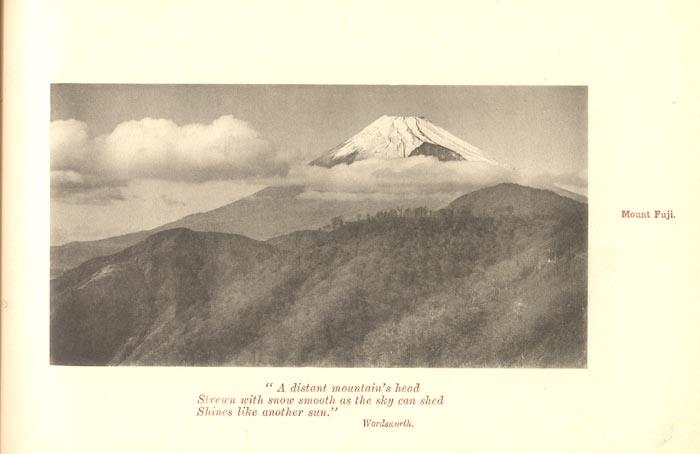
Herbert Ponting Mount Fuji

This photograph is the opening image of Ponting’s ‘Japanese Studies’
collotyped by K. Ogawa F.R.P.S. in Tokyo in 1906.

It is accompanied by a quote from a Wordsworth poem:
‘A distant mountain’s head, Strewn with snow smooth as the
sky can shed, Shines like another sun.’


The Great wall of China (1907)


Ponting expanded his photographs of Japan into a 1910 book, In Lotus-land Japan. He was elected a Fellow of the Royal Geographical Society (FRGS). His flair for journalism and ability to shape his photographic illustrations into a narrative led to his being signed as expedition photographer aboard the Terra Nova, the first time a professional photographer was included on an Antarctic expedition.
As a member of the shore party in early 1911, Ponting helped set up the Terra Nova Expedition's Antarctic winter camp at Cape Evans, Ross Island. The camp included a tiny photographic darkroom. Although the expedition came more than 20 years after the invention of photographic film, Ponting preferred high-quality images taken on glass plates.

Ponting was one of the first men to use a portable movie camera in Antarctica. The primitive device, called a cinematograph, could take short video sequences. Ponting also brought some autochrome plates to Antarctica and took some of the first known color still photographs there 


Herbert Ponting photograph of icebergs from Scott's last expedition  (1910)


Herbert George Ponting, Mt Erebus, Antarctica,  1911


Camp near Erebus, by Herbert George Ponting, 1911.

Members of the British Antarctic (“Terra Nova”) Expedition
unpacking provisions and getting their camp in order, in January 1911.


Ponting, Herbert George
The Terra Nova at the ice-foot, Cape Evans. 1911


The great white South; being an account of experiences
with Captain Scott's South pole expedition and of the nature life of the Antarctic

http://www.archive.org/details/greatwhitesouthb01pont


Robert Falcon Scott (1868-1912). Carbon print 35.6 x 45.7 cm 


The Terra Nova. In the pack - a lead opening up.
December 1910


Links: 

Royal Geographic Societ:  http://images.rgs.org/herbertponting.aspx
Ponting Portfolio: http://www.ponting-portfolio.com/

Terra Nova Expedition  http://en.wikipedia.org/wiki/Terra_Nova_Expedition


Comments

Popular posts from this blog

Group f/64 Manifesto (1932)

Ansel Adams by Dorothea Lange Group f/64 Manifesto The name of this Group is derived from a diaphragm number of the photographic lens. It signifies to a large extent the qualities of clearness and definition of the photographic image which is an important element in the work of members of this Group. The chief object of the Group is to present in frequent shows what it considers the best contemporary photography of the West; in addition to the showing of the work of its members, it will include prints from other photographers who evidence tendencies in their work similar to that of the Group. Group f/64 is not pretending to cover the entire of photography or to indicate through its selection of members any deprecating opinion of the photographers who are not included in its shows. There are great number of serious workers in photography whose style and technique does not relate to the metier of the Group. Group f/64 limits its members and invitational names to those worke...

Post-photography

"The job of the photographer in the 21st century has become increasingly challenging as the practice is an overwhelmingly populist business. Anyone who has access to a camera has the power to become an artist, leaving a plethora of cached evidence on the internet for public consumption. This “found” internet content serves as a vast laboratory for major experimentation, underpinning the concept of post-photography, with endless possibilities for artists to recreate original works using avant-garde techniques drawn from both the digital and analogue eras." Fiona Martin (short presentation of the book Post-Photography: The Artist with a Camera by Robert Shore) http://www.aestheticamagazine.com/post-photography / Perhaps there is less novelty here, regarding the context of photography transformed by the new image technologies developed in the late 20th century, in the particular sense that the early impact of photography itself transformed the regimes of vision and impact...

Hercules Florence, the isolated inventor of photography

Hercule Florence, self-portrait, c. 1875 source: http://www.mnemocine.com.br/fotografia/historia_foto.htm "Antoine Hercule Romuald Florence (1804–March 27, 1879) was a French-Brazilian painter and inventor, known as the isolate inventor of photography in Brazil, three years before Daguerre (but six years after Nicéphore Niépce), using the matrix negative/positive. According to Kossoy, who examined Florence's notes, he referred to his process, in French, as photographie in 1834, at least four years before John Herschel coined the English word photography." ( from: Hercules Florence - Wikipedia article ) "The notion of simultaneous invention - that two or more people can develop the same concept at about the same time - was mentioned by Florence and by another of photography's pioneer, William Henry Fox Talbot (1800-1877)" observes M. W. Marien : "Simultaneous invention makes it difficult to construct a linear chronology of photography." ( Marien, M...