Herbert George Ponting (1870–1935)


Young ladies by a pond, Japan (1907)


 from the book In Lotus Land (1910)


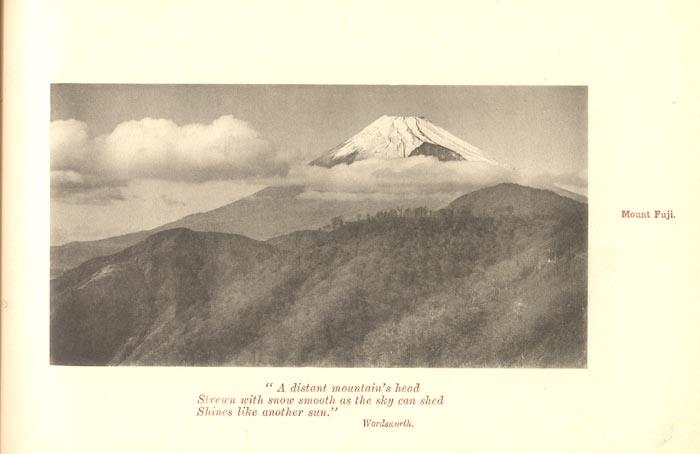
Herbert Ponting Mount Fuji

This photograph is the opening image of Ponting’s ‘Japanese Studies’
collotyped by K. Ogawa F.R.P.S. in Tokyo in 1906.

It is accompanied by a quote from a Wordsworth poem:
‘A distant mountain’s head, Strewn with snow smooth as the
sky can shed, Shines like another sun.’


The Great wall of China (1907)


Ponting expanded his photographs of Japan into a 1910 book, In Lotus-land Japan. He was elected a Fellow of the Royal Geographical Society (FRGS). His flair for journalism and ability to shape his photographic illustrations into a narrative led to his being signed as expedition photographer aboard the Terra Nova, the first time a professional photographer was included on an Antarctic expedition.
As a member of the shore party in early 1911, Ponting helped set up the Terra Nova Expedition's Antarctic winter camp at Cape Evans, Ross Island. The camp included a tiny photographic darkroom. Although the expedition came more than 20 years after the invention of photographic film, Ponting preferred high-quality images taken on glass plates.

Ponting was one of the first men to use a portable movie camera in Antarctica. The primitive device, called a cinematograph, could take short video sequences. Ponting also brought some autochrome plates to Antarctica and took some of the first known color still photographs there 


Herbert Ponting photograph of icebergs from Scott's last expedition  (1910)


Herbert George Ponting, Mt Erebus, Antarctica,  1911


Camp near Erebus, by Herbert George Ponting, 1911.

Members of the British Antarctic (“Terra Nova”) Expedition
unpacking provisions and getting their camp in order, in January 1911.


Ponting, Herbert George
The Terra Nova at the ice-foot, Cape Evans. 1911


The great white South; being an account of experiences
with Captain Scott's South pole expedition and of the nature life of the Antarctic

http://www.archive.org/details/greatwhitesouthb01pont


Robert Falcon Scott (1868-1912). Carbon print 35.6 x 45.7 cm 


The Terra Nova. In the pack - a lead opening up.
December 1910


Links: 

Royal Geographic Societ:  http://images.rgs.org/herbertponting.aspx
Ponting Portfolio: http://www.ponting-portfolio.com/

Terra Nova Expedition  http://en.wikipedia.org/wiki/Terra_Nova_Expedition


Comments

Popular posts from this blog

Group f/64 Manifesto (1932)

Ansel Adams by Dorothea Lange Group f/64 Manifesto The name of this Group is derived from a diaphragm number of the photographic lens. It signifies to a large extent the qualities of clearness and definition of the photographic image which is an important element in the work of members of this Group. The chief object of the Group is to present in frequent shows what it considers the best contemporary photography of the West; in addition to the showing of the work of its members, it will include prints from other photographers who evidence tendencies in their work similar to that of the Group. Group f/64 is not pretending to cover the entire of photography or to indicate through its selection of members any deprecating opinion of the photographers who are not included in its shows. There are great number of serious workers in photography whose style and technique does not relate to the metier of the Group. Group f/64 limits its members and invitational names to those worke...

Survey photography and the landscape in 19th century America

Carleton Watkins, The Vernal Fall, from the Yosemite Book, 1868 Carleton Watkins. Yosemite Falls and the Merced River. Yosemite National Park. View from the Sentinel Dome, Yosemite, by Carleton Watkins As Ian Jeffrey observed (1),  19th century American landscape photography recorded "virgin" nature in two complementary "modes": in the first, contemplating the novelty, and the magnitude of its subject, the photographer documents vast vistas from the distance, not simply physical distance per se  but a properly visual distance appropriated to handle the unique, novel forms of the subject. In the second, photographic vision "tames" nature and organizes the natural panorama by way of an aesthetic code akin to that of the contemporary landscape painters.  Survey photography by Weed, Watkins or by Muybridge, O' Sullivan, and others, can be seen as a kind of "second" conquest o...

The Photography of Everyday Life: Paul Martin (1864-1942)

Blind beggar at the cattle market, c.1890 Paul Martin British, 1864 - 1942 Platinum print 18 x 22.8cm Dancing to the organ, Lambeth, 1893 Platinum print 10 x 7.5cm The Old Empire Platinum print 17.5 x 23.5cm Southend Beach, 1905 Yarmouth sands, 1892 Link: Victoria and Albert Museum: Exploring Photography